No one is an island
Completed worlds in themselves, irreconcilable trajectories, parallel lines, yet everything is connected and interdependent. Each gesture or action creates a domino effect of consequences. Synergies.
This sound installation arises from the need to reflect on and respond to the emotional disconnection experienced during the COVID-19 pandemic.
In which each individual is divided and separated while remaining transparent, always visible, but untouchable.
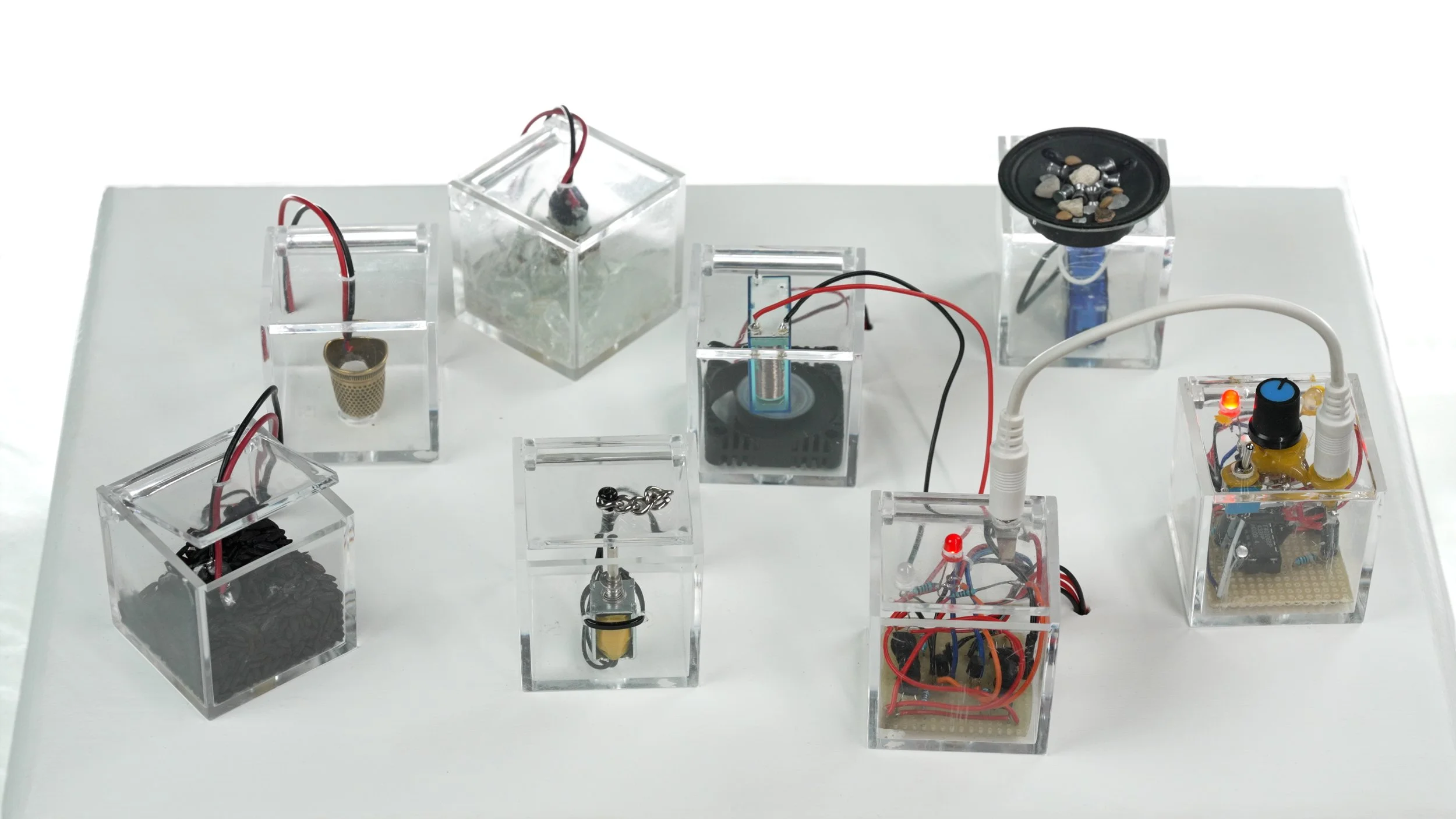
My sound boxes are like little creatures – almost animals. They are small and fragile entities, subjects and not objects.
Some dig in the rubble, others sow, there are those who do not know where to turn their heads and those who touch each other producing small sparks. They are separate, but at the same time they are connected. They are accessible, but unreachable. Trapped in their four plastic walls, yet they produce sounds that can float freely in the air we breathe.
No one can survive without the help of others and the "others" are also ourselves.
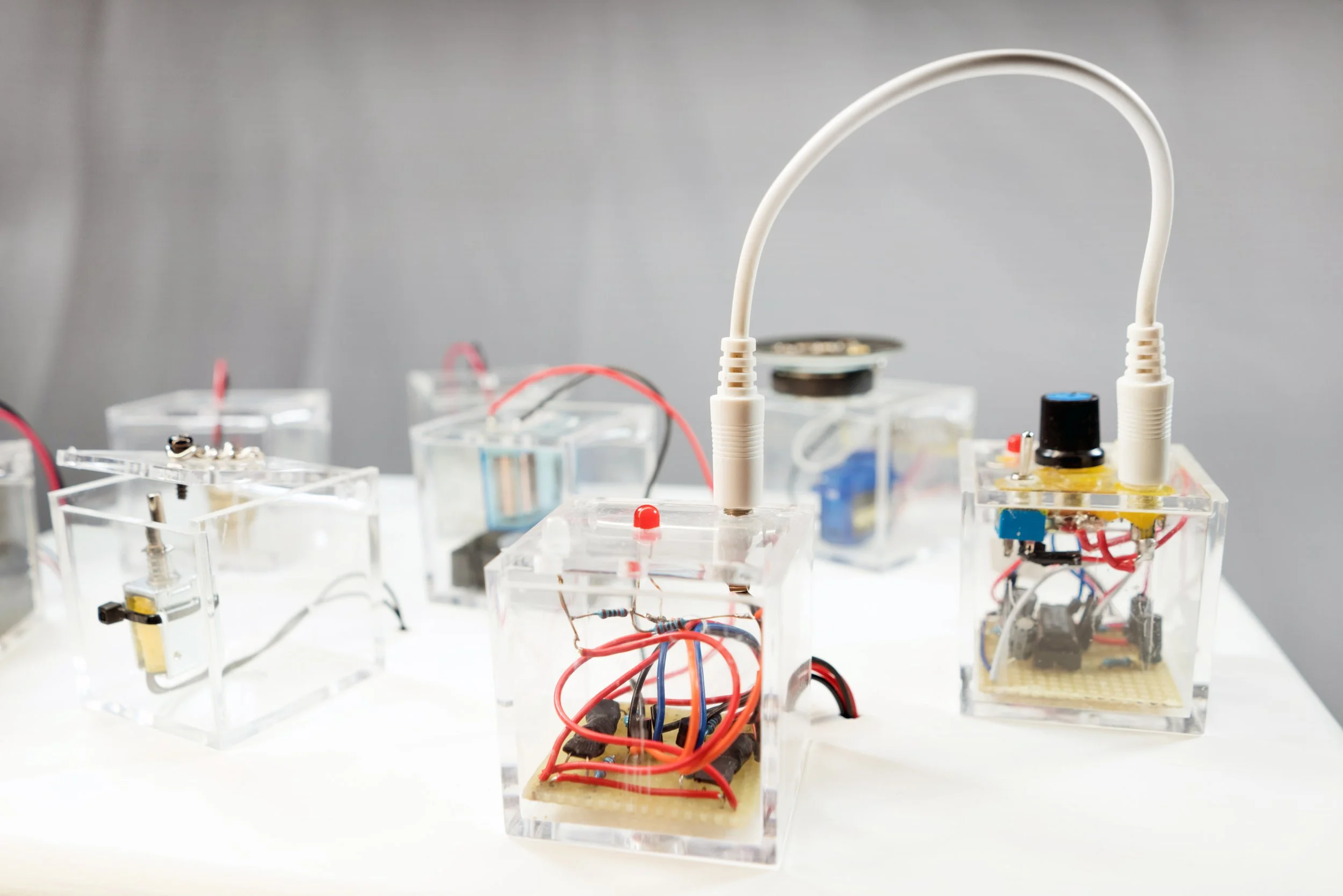
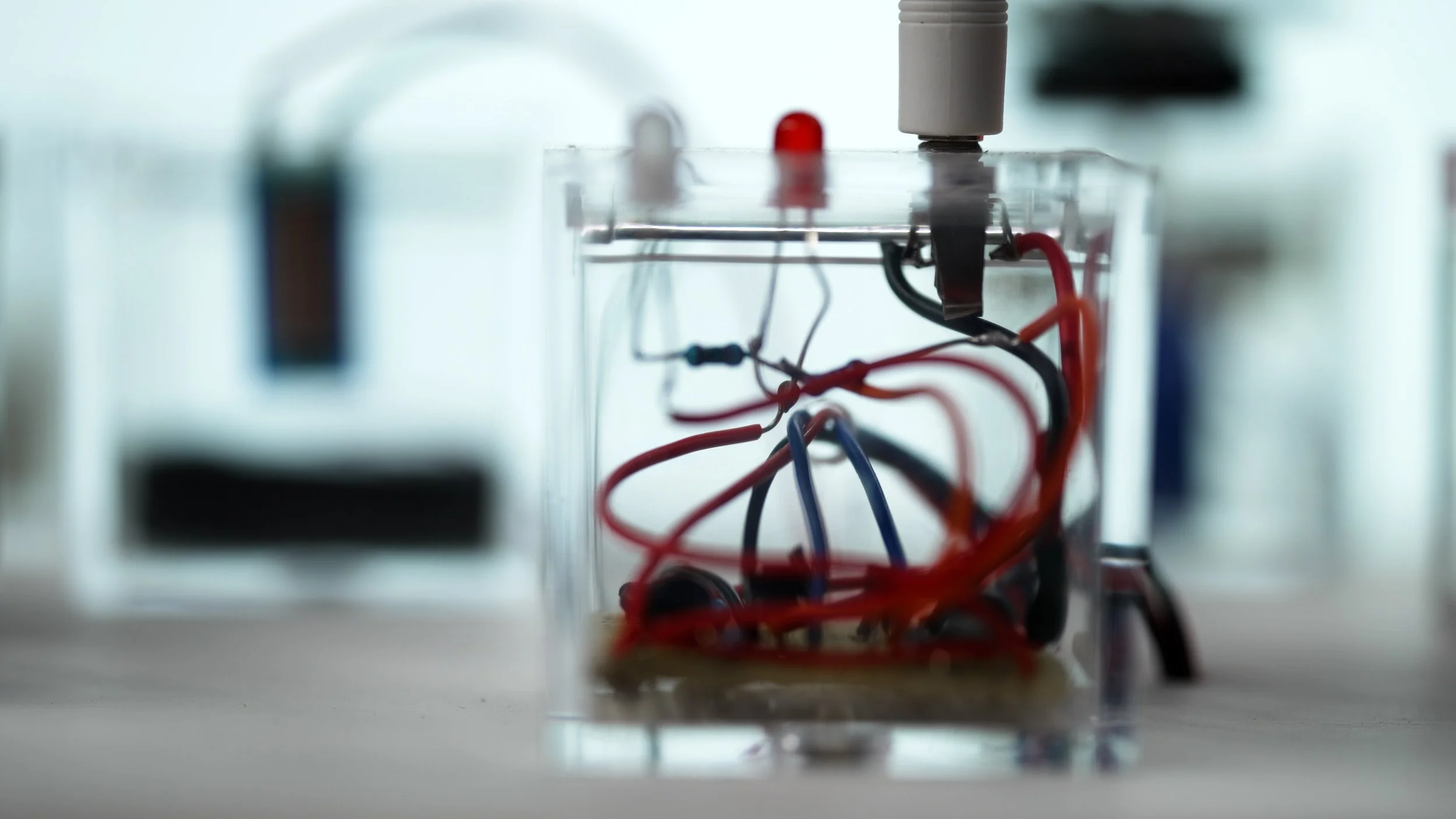
Island #1
A DC motor moves black rice inside the box. At the bottom of the box there is a piezo contact microphone which picks up the sounds of the rice and sends it to the mixer (4 channels) below, inside the box.
Island #2
Here I used a 3V micro DC motor from a mobile phone.
Through its vibration it excites a sewing thimble.
Island #3
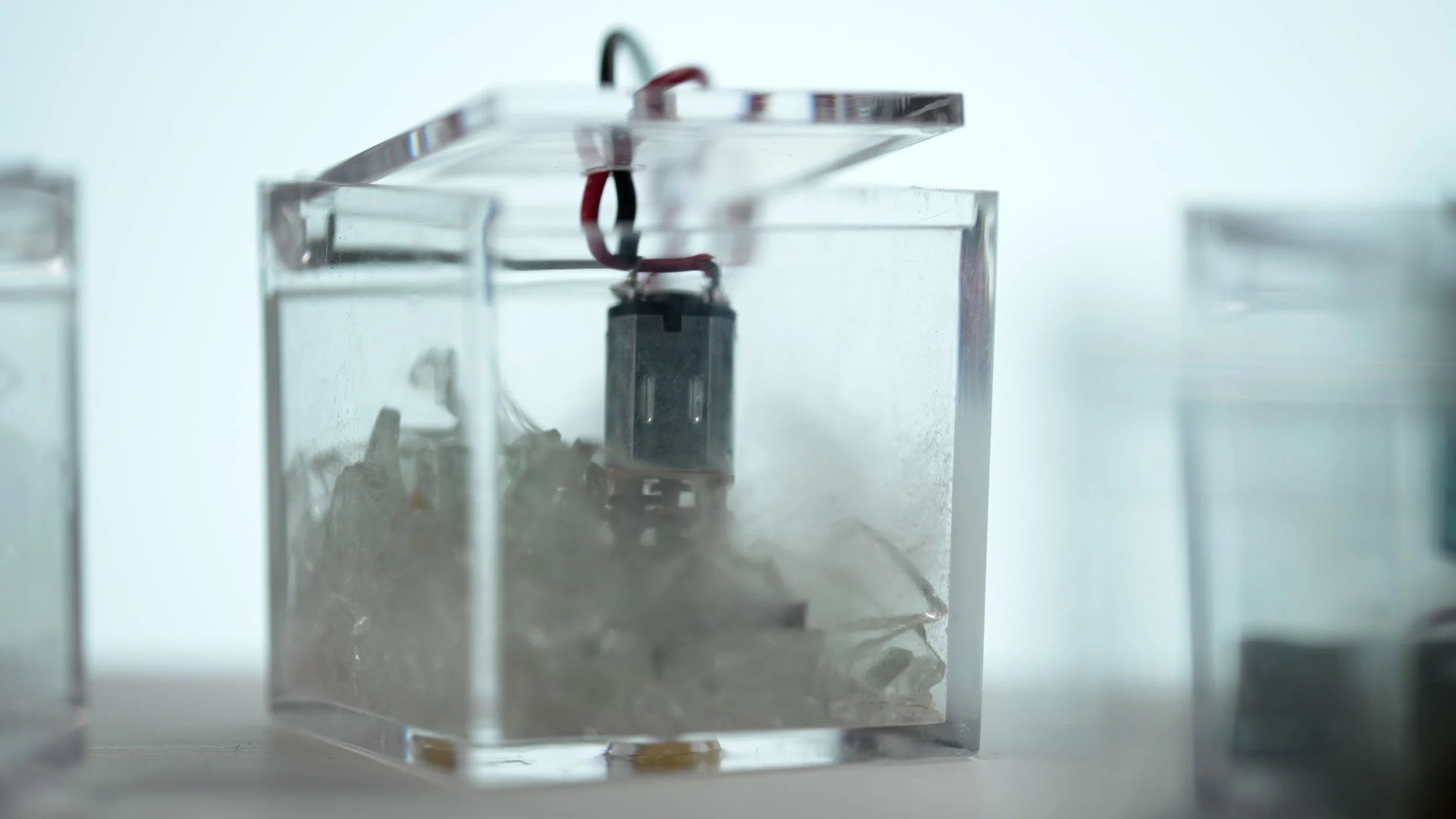
A DC motor moves fragments of glass inside the box. At the bottom of the box there is a piezoelectric microphone which picks up the sounds of the fragments and sends it to the mixer.
Island #4
A solenoid hits the lid of the box. Above the lid I attached a small chain with a screw to enrich the timbre.
Island #5
I use the coil of a relay as a sort of pickup for the guitar, which is placed above a mini PC fan. By adjusting the fan speed randomly, I change the pitch received by the relay.
The output from the relay is sent to Island #6.
Island #6
I built a double low-pass gate, using a couple of homemade vactrols.
I was inspired by the Buchla 292 module.
The sound sources come from sound islands #5 and #8.
The two audio outputs are sent to the mixer.
Island #7
Here I use a servo motor and a small speaker.
I applied a spring connected to the “+” of the speaker to the rotor of the servo.
On one side of the box, there is conductive material that I connected to the “+” of a 3V power supply. When the servo motor rotates, it hits the material and the circuit closes for an instant and makes the speaker sound, which is receiving electrical current.
Above the speaker, I placed some waste material, such as screws and small bolts.
Island #8
Here I built an oscillator with the integrated circuit “CD40106”.
The knob at the top allows to vary the frequency of the oscillator, which is basically very low, almost an LFO.
The audio output is sent to Island #6 by a 3.5 mm TS unbalanced cable.
The principle of operation of this sound installation is pretty simple.
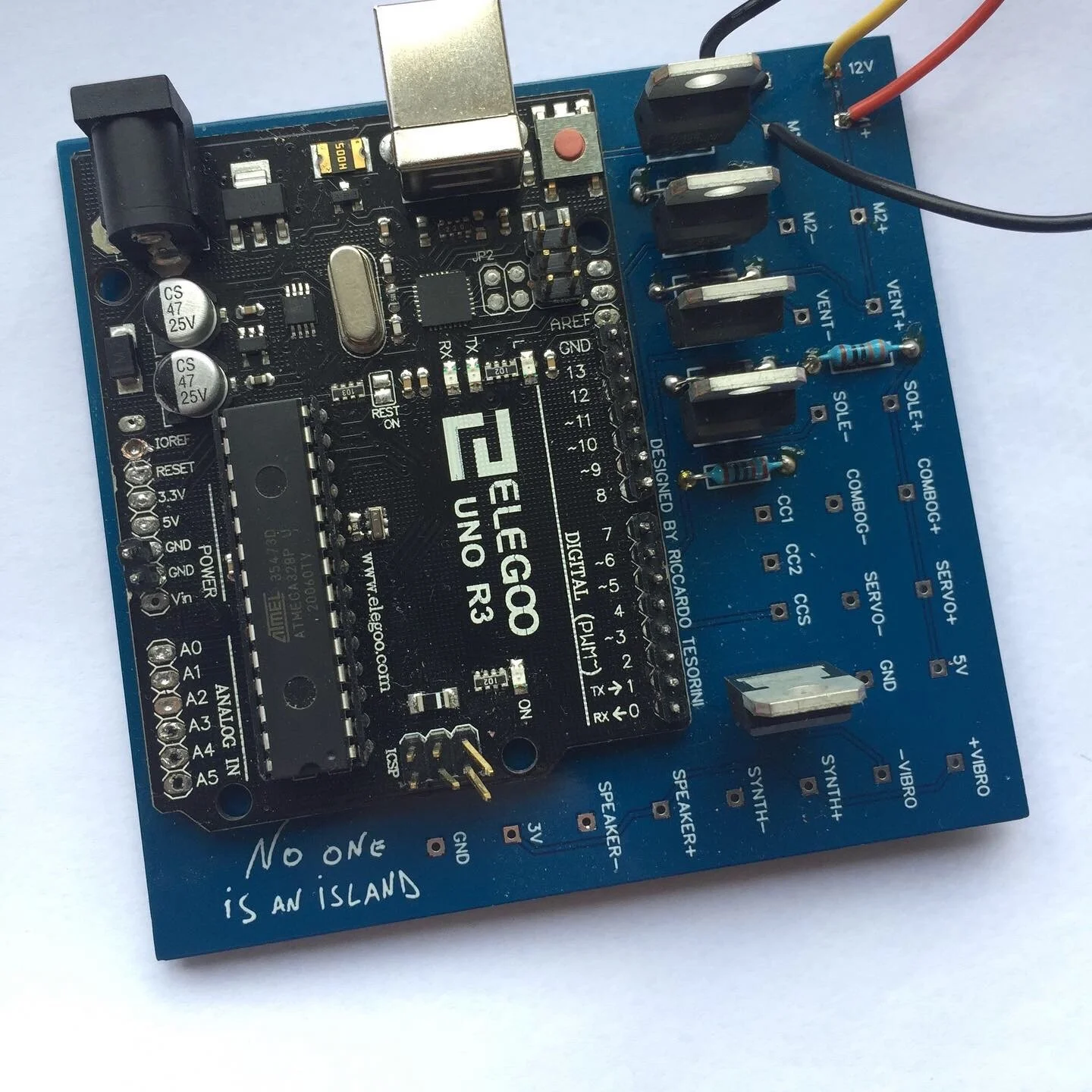
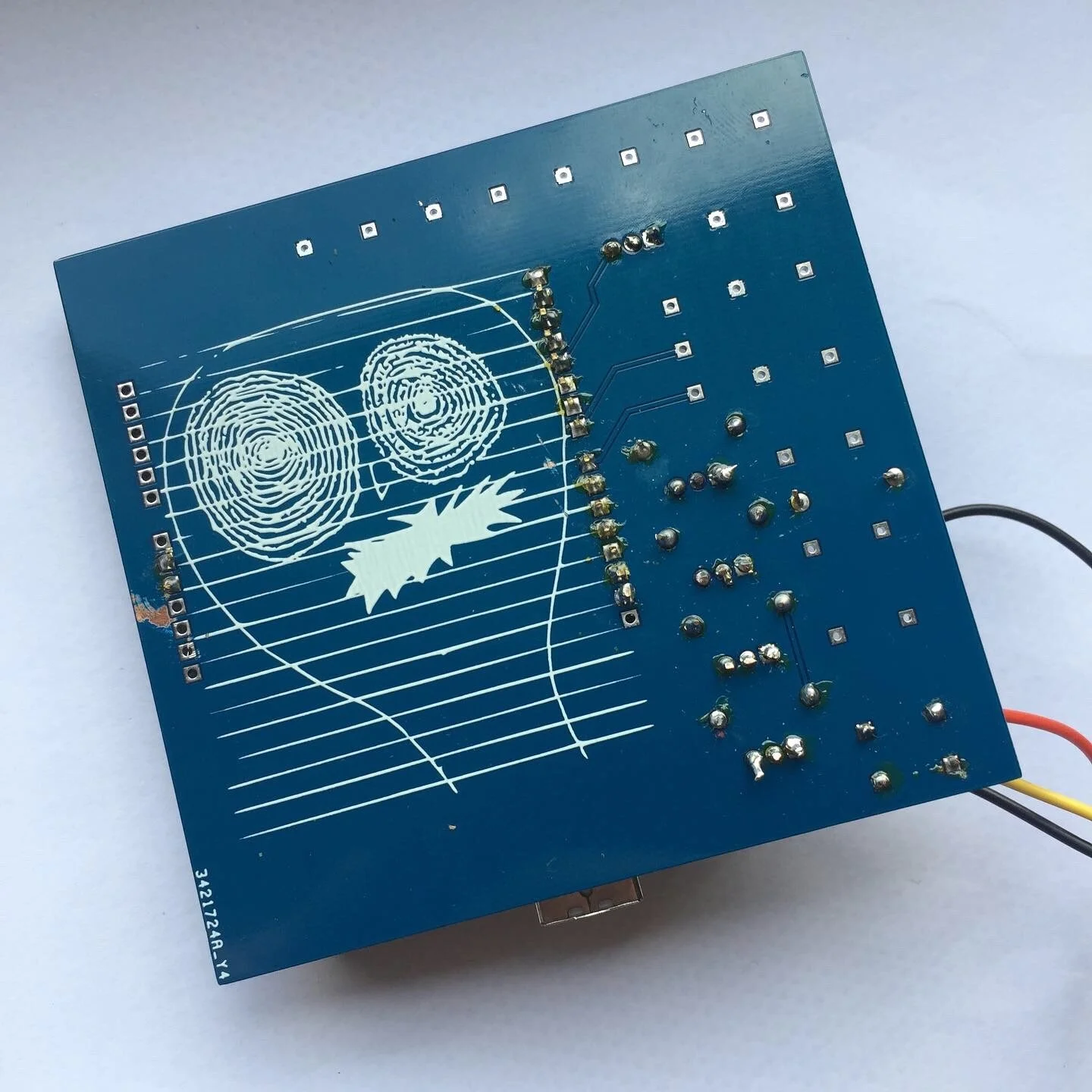
An Arduino board sends multiple impulses through the cables. Then, I fixed the cables to clamps and they go to the “islands”.
A 4-channel mixer takes the sounds from the piezo microphones of Islands #1 and #3, as well as from the audio outputs of Islands #5 and #8 that pass through Island #6.
The mixed output goes to a 50 W amplifier that sends audio to the sound exciters.
The sound exciters are in contact with the wooden box; this causes the sound to come straight out of the box without the use of another speaker.
The acoustic effect is very peculiar.
Everything is powered by the ATX power supply. To make the installation work, just plug in the VDE power cable.